Rotamer Toggle
DESCRIPTION
Backbone-Dependent Rotamer library (Dunbrack, Cohen ; see ref) is imported into pymol giving access to this information. There are a number of different ways to use the data, I've only implemented a few as well as added extra functions that seemed useful.
- Rotamer Menu - an added menu into menu.py, which displays the most common rotamers for the given(clicked) residue; you can also set the residue any of the common rotamers as well
- colorRotamers - color rotamers by closest matching rotamer angles from database; i.e. color by how common each rotamer of selection, blue - red (least to most common).
- set_rotamer - routine called by above menu, but can be called manually to set a specific residues side-chain angles
- set_phipsi - set all phi,psi angles of given selection to given angles (useful for creating secondary structures)
- createRotamerPDBs - create pdb for each rotamer of given selection ; filter by rotamer-probability
IMAGES
-
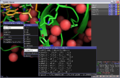 Rotamer Menu for a GLN residue
 -
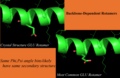 Rotamer Comparison of crystal structure and most common for GLU; just as an example


Print out while selecting most common rotamer from above-left image (GLN residue):
 Given GLN:40 PHI,PSI (-171.626373291,-96.0500335693) : bin (-170,-100)
 CHIs: [179.18069458007812, 72.539344787597656, -47.217315673828125]
 Setting Chi1 to -176.9
 Setting Chi2 to 177.4
 Setting Chi3 to 0.7
SETUP
run "rotamers.py" and use functions from commandline.
or
To setup a rotamer menu inside the residue menu (default windows pymol installation):
- copy rotamers.py to C:/Program Files/DeLano Scientific/PyMol/modules/pymol/rotamers.py
- copy mymenu.py to C:/Program Files/DeLano Scientific/PyMol/modules/pymol/menu.py (WARNING : overwrites default menu.py - use at your own risk)
- copy bbdep02.May.sortlib to C:/Program Files/DeLano Scientific/PyMol/modules/pymol/bbdep02.May.sortlib (or newer version of sorted bbdep)
This is only one possible way to do this, I am sure there are many others. I'm not going to post the bbdep, but there is a link in the References section to Dunbrack's download page (get the "sorted" lib)
NOTES / STATUS
- Tested on Pymolv0.97, Windows platform, Red Hat Linux 9.0 and Fedora Core 4. Will test v0.98 and MacOSX later on.
- The way it's setup now, when you import rotamers , it will automatically read-in the rotamer database; this may not be what you want.
- Post problems in the discussion page, on 'my talk' page or just email me : dwkulp@mail.med.upenn.edu
TASKS TODO:
- Rotamer Movie, using mset, etc create movie to watch cycle through rotamers
- Code could be organized a bit better; due to time constraints this is good for now..
TASKS DONE:
- Store crystal structure in rotamer menu, so you can go back to original orientation
USAGE
colorRotamers selection
set_rotamer selection, chi1_angle [,chi2_angle] [,chi3_angle] [,chi4_angle]
set_phipsi selection phi_angle, psi_angle
createRotamerPBDs selection [,ncutoff] [,pcutoff] [,prefix]
EXAMPLES
  colorRotamers chain A
  set_rotamer resi 40, -60,-40   (only set chi1,chi2 angles)
  set_phipsi resi 10-40, -60,-60 (create an alpha-helical-like section)
  createRotamerPDBs resi 10-12, ncutoff=3 (create 9 PDBs; each with one of the 3 most probable rotamers for resi 10,11,12)
  createRotamerPDBs resi 14, pcutoff=0.4  (create a pdb file for each rotamer of residue 14 with probablity > 0.4)
REFERENCES
Dunbrack and Cohen. Protein Science 1997
Dunbrack Lab Page (Contains backbone-dependent library)
SCRIPTS (Rotamers.py ; MyMenu.py)
Rotamers.py
##################################################################
# File:          Rotamers.py
# Author:        Dan Kulp
# Creation Date: 6/8/05
# Contact:       dwkulp@mail.med.upenn.edu
#
# Notes:
#     Incorporation of Rotamer library
#     readRotLib() - fills rotdat;
#        indexed by "RES:PHI_BIN:PSI_BIN".
#
#     Three main functions:
#     1. colorRotamers - colors according
#          to rotamer probablitity
#     2. getBins(sel)
#           phi,psi bin for rotamer
#     3. set_rotamer - set a side-chain
#           to a specific rotamer
#
#     To setup a rotamer menu in the
#   right click, under "Residue"
#        1. cp mymenu.py modules/pymol/menu.py
#        2. cp rotamers.py modules/pymol/rotamers.py (update ROTLIB)
#
# Requirements:
#  set ROTLIB to path for rotamer library
# Reference:
#  Dunbrack and Cohen. Protein Science 1997
####################################################################

import colorsys,sys
import editing
import os
import cmd
import math

# Path for library
ROTLIB=os.environ['PYMOL_PATH']+"/modules/pymol/bbdep02.May.sortlib"

# Place for library in memory..
rotdat = {}

def readRotLib():
    # Column indexes in rotamer library..
    RES  = 0
    PHI  = 1
    PSI  = 2
    PROB = 8
    CHI1 = 9
    CHI2 = 10
    CHI3 = 11
    CHI4 = 12

    if os.path.exists(ROTLIB):
                print "File exists: "+ROTLIB
                input = open(ROTLIB, 'r')
                for line in input:

                    # Parse by whitespace (I believe format is white space and not fixed-width columns)
                    dat = line.split()

                    # Add to rotamer library in memory :
                    #   key format       RES:PHI_BIN:PSI_BIN
                    #   value format     PROB, CHI1, CHI2, CHI3, CHI4
                    key=dat[RES]+":"+dat[PHI]+":"+dat[PSI]
                    if key in rotdat:
                        rotdat[key].append([ dat[PROB], dat[CHI1], dat[CHI2], dat[CHI3], dat[CHI4] ])
                    else:
                        rotdat[key] = [ [ dat[PROB], dat[CHI1], dat[CHI2], dat[CHI3], dat[CHI4] ] ]


    else:
        print "Couldn't find Rotamer library"


# Atoms for each side-chain angle for each residue
CHIS = {}
CHIS["ARG"] = [ ["N","CA","CB","CG" ],
                ["CA","CB","CG","CD" ],
                ["CB","CG","CD","NE" ],
                ["CG","CD","NE","CZ" ]
              ]

CHIS["ASN"] = [ ["N","CA","CB","CG" ],
                ["CA","CB","CG","OD2" ]
              ]

CHIS["ASP"] = [ ["N","CA","CB","CG" ],
                ["CA","CB","CG","OD1" ]
              ]
CHIS["CYS"] = [ ["N","CA","CB","SG" ]
              ]

CHIS["GLN"] = [ ["N","CA","CB","CG" ],
                ["CA","CB","CG","CD" ],
                ["CB","CG","CD","OE1"]
              ]

CHIS["GLU"] = [ ["N","CA","CB","CG" ],
                ["CA","CB","CG","CD" ],
                ["CB","CG","CD","OE1"]
              ]

CHIS["HIS"] = [ ["N","CA","CB","CG" ],
                ["CA","CB","CG","ND1"]
              ]

CHIS["ILE"] = [ ["N","CA","CB","CG1" ],
                ["CA","CB","CG1","CD1" ]
              ]

CHIS["LEU"] = [ ["N","CA","CB","CG" ],
                ["CA","CB","CG","CD1" ]
              ]

CHIS["LYS"] = [ ["N","CA","CB","CG" ],
                ["CA","CB","CG","CD" ],
                ["CB","CG","CD","CE"],
                ["CG","CD","CE","NZ"]
              ]

CHIS["MET"] = [ ["N","CA","CB","CG" ],
                ["CA","CB","CG","SD" ],
                ["CB","CG","SD","CE"]
              ]

CHIS["PHE"] = [ ["N","CA","CB","CG" ],
                ["CA","CB","CG","CD1" ]
              ]

CHIS["PRO"] = [ ["N","CA","CB","CG" ],
                ["CA","CB","CG","CD" ]
              ]

CHIS["SER"] = [ ["N","CA","CB","OG" ]
              ]

CHIS["THR"] = [ ["N","CA","CB","OG1" ]
              ]

CHIS["TRP"] = [ ["N","CA","CB","CG" ],
                ["CA","CB","CG","CD1"]
              ]

CHIS["TYR"] = [ ["N","CA","CB","CG" ],
                ["CA","CB","CG","CD1" ]
              ]

CHIS["VAL"] = [ ["N","CA","CB","CG1" ]
              ]

# Color Rotamer by side-chain angle position
#  'bin' side-chain angles into closest
def colorRotamers(sel):
    doRotamers(sel)

# Utility function, to set phi,psi angles for a given selection
# Note: Cartoon, Ribbon functionality will not display correctly after this
def set_phipsi(sel, phi,psi):
    doRotamers(sel,angles=[phi,psi],type="set")

# Set a rotamer, based on a selection, a restype and chi angles
def set_rotamer(sel, chi1, chi2=0,chi3=0,chi4=0):
    at = cmd.get_model("byres ("+sel+")").atom[0]

    list = [chi1,chi2,chi3,chi4]
    for i in range(len(CHIS[at.resn])):
        print "Setting Chi"+str(i+1)+" to "+str(list[i])
        editing.set_dihedral(sel + ' and name '+CHIS[at.resn][i][0],
                             sel + ' and name '+CHIS[at.resn][i][1],
                             sel + ' and name '+CHIS[at.resn][i][2],
                             sel + ' and name '+CHIS[at.resn][i][3], str(list[i]))

    # Remove some objects that got created
    cmd.delete("pk1")
    cmd.delete("pk2")
    cmd.delete("pkmol")

# Get Phi,Psi bins for given selection
# WARNING:  assume selection is single residue (will only return first residue bins)
def getBins(sel):
    return doRotamers(sel, type="bins")

# Color Ramp...
def rot_color(vals):
        nbins = 10
        vals.sort(key=lambda x:x[1])
#       print "End sort: "+str(len(vals))+" : "+str(nbins)


        # Coloring scheme...
        j = 0
        rgb = [0.0,0.0,0.0]
        sel_str = ""
        for i in range(len(vals)):
                if int(len(vals)/nbins) == 0 or i % int(len(vals)/nbins) == 0:
                      hsv = (colorsys.TWO_THIRD - colorsys.TWO_THIRD * float(j) / (nbins-1), 1.0, 1.0)

                      #convert to rgb and append to color list
                      rgb = colorsys.hsv_to_rgb(hsv[0],hsv[1],hsv[2])
                      if j < nbins-1:
                              j += 1

                cmd.set_color("RotProbColor"+str(i), rgb)
                cmd.color("RotProbColor"+str(i), str(vals[i][0]))


# Main function
def doRotamers(sel,angles=[], type="color"):

        # Read in Rotamer library if not already done
        if len(rotdat) == 0:
                readRotLib()

        # Set up some variables..
        residues = ['dummy']  # Keep track of residues already done
        probs = []            # probability of each residue conformation
        phi = 0               # phi,psi angles of current residue
        psi = 0

        # Get atoms from selection
        atoms = cmd.get_model("byres ("+sel+")")

        # Loop through atoms in selection
        for at in atoms.atom:
            try:
               # Don't process Glycines or Alanines
               if not (at.resn == 'GLY' or at.resn == 'ALA'):
                if at.chain+":"+at.resn+":"+at.resi not in residues:
                    residues.append(at.chain+":"+at.resn+":"+at.resi)

                    # Check for a null chain id (some PDBs contain this)
                    unit_select = ""
                    if at.chain != "":
                        unit_select = "chain "+str(at.chain)+" and "

                    # Define selections for residue i-1, i and i+1
                    residue_def = unit_select+'resi '+str(at.resi)
                    residue_def_prev = unit_select+'resi '+str(int(at.resi)-1)
                    residue_def_next = unit_select+'resi '+str(int(at.resi)+1)

                    # Compute phi/psi angle

                    phi = cmd.get_dihedral(residue_def_prev+' and name C',residue_def+' and name N',residue_def+' and name CA',residue_def+' and name C')
                    psi = cmd.get_dihedral(residue_def+' and name N',residue_def+' and name CA',residue_def+' and name C',residue_def_next+' and name N')
                    if type == "set":
                            print "Changing "+at.resn+str(at.resi)+" from "+str(phi)+","+str(psi)+" to "+str(angles[0])+","+str(angles[1])
                            cmd.set_dihedral(residue_def_prev+' and name C',residue_def+' and name N',residue_def+' and name CA',residue_def+' and name C',angles[0])
                            cmd.set_dihedral(residue_def+' and name N',residue_def+' and name CA',residue_def+' and name C',residue_def_next+' and name N', angles[1])
                            continue

                    # Find correct 10x10 degree bin
                    phi_digit = abs(int(phi)) - abs(int(phi/10)*10)
                    psi_digit = abs(int(psi)) - abs(int(psi/10)*10)

                    # Remember sign of phi,psi angles
                    phi_sign = 1
                    if phi < 0:    phi_sign = -1

                    psi_sign = 1
                    if psi < 0:    psi_sign = -1

                    # Compute phi,psi bins
                    phi_bin = int(math.floor(abs(phi/10))*10*phi_sign)
                    if phi_digit >= 5:    phi_bin = int(math.ceil(abs(phi/10))*10*phi_sign)

                    psi_bin = int(math.floor(abs(psi/10))*10*psi_sign)
                    if psi_digit >= 5:    psi_bin = int(math.ceil(abs(psi/10))*10*psi_sign)

                    print "Given "+at.resn+":"+at.resi+" PHI,PSI ("+str(phi)+","+str(psi)+") : bin ("+str(phi_bin)+","+str(psi_bin)+")"


                    # Get current chi angle measurements
                    chi = []
                    for i in range(len(CHIS[at.resn])):
                       chi.append(cmd.get_dihedral(residue_def + ' and name '+CHIS[at.resn][i][0],
                                                     residue_def + ' and name '+CHIS[at.resn][i][1],
                                                     residue_def + ' and name '+CHIS[at.resn][i][2],
                                                     residue_def + ' and name '+CHIS[at.resn][i][3]))
                    print "CHIs: "+str(chi)
                    if type == 'bins':
                         return [at.resn, phi_bin,psi_bin]

                    # Compute probabilities for given chi angles
                    prob = 0
                    prob_box = 22
                    for item in range(len(rotdat[at.resn+":"+str(phi_bin)+":"+str(psi_bin)])):
                        print "Rotamer from db: "+str(rotdat[at.resn+":"+str(phi_bin)+":"+str(psi_bin)][item])
                        if chi[0]:
                            if chi[0] >= float(rotdat[at.resn+":"+str(phi_bin)+":"+str(psi_bin)][item][1]) - (prob_box/2) and \
                                chi[0] <= float(rotdat[at.resn+":"+str(phi_bin)+":"+str(psi_bin)][item][1]) + (prob_box/2):
                                if len(chi) == 1:
                                        prob = rotdat[at.resn+":"+str(phi_bin)+":"+str(psi_bin)][item][0]
                                        break
                                if chi[1] >= float(rotdat[at.resn+":"+str(phi_bin)+":"+str(psi_bin)][item][2]) - (prob_box/2) and \
                                 float(chi[1] <= rotdat[at.resn+":"+str(phi_bin)+":"+str(psi_bin)][item][2]) + (prob_box/2):
                                        if len(chi) == 2:
                                            prob = rotdat[at.resn+":"+str(phi_bin)+":"+str(psi_bin)][item][0]
                                            break
                                        if chi[2] >= float(rotdat[at.resn+":"+str(phi_bin)+":"+str(psi_bin)][item][3]) - (prob_box/2) and \
                                           float(chi[2] <= rotdat[at.resn+":"+str(phi_bin)+":"+str(psi_bin)][item][3]) + (prob_box/2):
                                            if len(chi) == 3:
                                                prob = rotdat[at.resn+":"+str(phi_bin)+":"+str(psi_bin)][item][0]
                                                break
                                            if chi[3] >= float(rotdat[at.resn+":"+str(phi_bin)+":"+str(psi_bin)][item][4]) - (prob_box/2) and \
                                               float(chi[3] <= rotdat[at.resn+":"+str(phi_bin)+":"+str(psi_bin)][item][4]) + (prob_box/2):
                                                prob = rotdat[at.resn+":"+str(phi_bin)+":"+str(psi_bin)][item][0]
                                                break


                    print "PROB OF ROTAMER: "+str(prob)
                    print "---------------------------"
                    probs.append([residue_def, prob])

            except:
#               probs.append([residue_def, -1])
                print "Exception found"
                continue

        # Color according to rotamer probability
        rot_color(probs)


#  Create PDB files containing most probable rotamers
def createRotamerPDBs(sel,ncutoff=10,pcutoff=0,prefix="ROTAMER"):

        # Get atoms from selection
        atoms = cmd.get_model("byres ("+sel+")")

        # Set up some variables..
        residues = ['dummy']  # Keep track of residues already done

        # Loop through atoms in selection
        for at in atoms.atom:
                if at.resn in ('GLY','ALA') or "%s:%s:%s" % (at.chain,at.resn,at.resi) in residues:
                        continue

                # Add to residue list (keep track of which ones we've done)
                residues.append("%s:%s:%s" % (at.chain,at.resn,at.resi))

                # Check for a null chain id (some PDBs contain this)
                unit_select = ""
                if not at.chain == "":
                    unit_select = "chain "+str(at.chain)+" and "

                # Define selections for residue
                residue_def = unit_select+'resi '+str(at.resi)

                # Get bin (phi,psi) definitions for this residue
                bin = doRotamers(residue_def, type='bins')

                # Store crystal angle
                crystal_angles = [0.0,0.0,0.0,0.0]
                for angle in range(3):
                        try:
                                crystal_angles[angle] = bin[3][angle]
                        except IndexError:
                                break

                # Retreive list of rotamers for this phi,psi bin + residue type
                match_rotamers = rotdat["%s:%s:%s" % (bin[0],str(bin[1]),str(bin[2]))]

                count = 0
                for item in range(len(match_rotamers)):

                        # Store probablity
                        prob = match_rotamers[item][0]

                        # Check cutoffs
                        if float(prob) <= float(pcutoff):
                                continue

                        if float(count) >= float(ncutoff):
                                break

                        # Increment count
                        count += 1

                        # Output to screen ...
                        print "Residue %s%s, rotamer %i, prob %s" % (str(at.resn),str(at.resi),int(item),str(prob))

                        # Set to new rotamer
                        set_rotamer(residue_def,match_rotamers[item][1],match_rotamers[item][2],match_rotamers[item][3],match_rotamers[item][4])

                        # Store in PDB file
                        cmd.save("%s_%s%s_%i_%s.pdb" % (prefix,str(at.resn),str(at.resi),int(item),str(prob)))

                        # Reset crystal angle
                        set_rotamer(residue_def,crystal_angles[0],crystal_angles[1],crystal_angles[2],crystal_angles[3])

# Uncommenting this is nice because it loads rotamer library upon startup
#  however, it slows the PyMOL loading process a lot
#  instead I've put this call into the menuing code..
# readRotLib()

cmd.extend('set_phipsi',set_phipsi)
cmd.extend('set_rotamer',set_rotamer)
cmd.extend('colorRotamers',colorRotamers)
cmd.extend('createRotamerPDBs',createRotamerPDBs)
MyMenu.py
Since menu.py is copyrighted I can't post my edited version, but you can create it very simply by adding these two peices of code
1. In the "pick_option(title,s,object=0)" function of menu.py add the following code after the first "result =" statement
# Edit dwkulp 6/11/05 , add a rotamer menu to residue menu
   if title == 'Residue':
	result.extend([[ 1, 'rotamers'    , rotamer_menu(s)]])
2. At the end of the file add this:
###############################################
# Dan Kulp
# Added Rotamer list to residue menu..
# rotamer.py must be importable (I placed it in
# the same directory as menu.py)
###############################################

import rotamers


def rotamer_menu(s):
	# Check for rotamer library being loaded
	if not rotamers.rotdat:
             rotamers.readRotLib()
#	     return [ [2, "Must run rotamers.py first",'']]

	# Check for valid rotamer residue..
	res = cmd.get_model("byres ("+s+")").atom[0].resn
        if not res in rotamers.CHIS.keys():
	    return [ [2, "Residue: "+res+" not known sidechain or does not have rotamers", '']]

	# Get PHI,PSI bins for rotamer (also prints out current phi,psi, chi1,chi2,chi3,chi4)
	bins = rotamers.doRotamers(s,type='bins')

	# Add a title to the menu
	result = [ [2, bins[0]+' Rotamers in bin ('+str(bins[1])+','+str(bins[2])+')','' ], [1, ':::PROB,CHI1,CHI2,CHI3,CHI4:::','']]

        # Grab the entries for this residue and phi,psi bins
	match_rotamers = rotamers.rotdat[bins[0]+":"+str(bins[1])+":"+str(bins[2])]

	# Set max number of rotamers to display (probably should be somewhere 'higher up' in the code)
	max_rotamers = min(10, len(match_rotamers))

	# Create menu entry for each possible rotamer
        for item in range(max_rotamers):
             result.append( [ 1, str(match_rotamers[item]), 'rotamers.set_rotamer("'+s+'","'\
										    +str(match_rotamers[item][1])+'","'\
										    +str(match_rotamers[item][2])+'","'\
										    +str(match_rotamers[item][3])+'","'\
										    +str(match_rotamers[item][4])+'")'])
	return result